Building an Impact Economy in Georgia
Connecting Georgia’s social enterprises to markets and capital




Connecting Georgia’s social enterprises to markets and capital

 102
102
 0
0
Gabriel Grant on giving shareholders a way to express what matters to them
 107
0
107
0

For mission-led organizations, a change of manager tests whether workplace inclusion is built to last.
 84
0
84
0

Why free education tools need reliable access, credible evidence, and lasting support
 457
0
457
0

What Islamic finance and impact investing can learn from each other
 465
0
465
0

After the flood, recovery capital must do more than replace what was lost
 425
0
425
0

 680
0
680
0

Short-term shelter can provide immediate safety and stability, but it cannot substitute for the long-term housing systems recovery requires; Photo credit Getty Images
Airbnb.org’s partnership with 211 LA after the Eaton Fire reveals both the power and the discomfort of platform-enabled crisis response. Its model can move quickly, using trusted local referral networks and a distributed host community to provide emergency housing. But it also raises a harder question for the Impact Economy: how do we welcome private-sector capacity in moments of urgent need without mistaking relief for structural repair — or allowing the source of that capacity to escape scrutiny?
The fire began on January 7, 2025, on the eastern hillside above Eaton Canyon Wash. Within minutes, wind-driven embers were setting structures ablaze nearly a mile away. California's Eaton Fire burned for 24 days, killed 19 people, and consumed more than 14,000 acres.
Maribel Marin, executive director of 211 LA, had been on alert since January 3. “We were already out in the field, talking to folks, getting them ready.” When the fire swept through, her team was ready, too.
That evening, through its partnership with 211 Ventura, Marin's team connected with Airbnb.org. Within hours, they had agreed: 100 families would receive seven-day emergency stays. The county activated 211 LA that same night. By January 2026, a response launched within 24 hours of the Palisades and Eaton wildfires had helped provide free emergency housing for nearly 24,000 people, including more than 1,000 first responders.
211 LA opened its doors in 1981 and serves as a centralized broker of vetted information for non-life-threatening situations, as well as a critical triage layer during disasters, when misinformation is often widespread. Airbnb.org, the nonprofit founded by Airbnb, brings a different kind of capacity: access to a global host network, a mechanism for placing people quickly in free or discounted stays, and an operating model in which Airbnb covers overhead so public donations fund housing directly.

Wildfire smoke over Los Angeles underscores the growing pressure on emergency housing systems as climate-related displacement becomes more frequent; Photo by Jessica Christian
The fit seems obvious once you see it. “They have the team that gets the resources,” Marin explains. “We have the agents who can do intake and make referrals and warm connections.” The logic has since extended beyond Los Angeles: Airbnb.org has built similar relationships with 211 organizations across the country.
For Christoph Gorder, executive director of Airbnb.org, the partnership reflects hard-won lessons about what technology-enabled humanitarian response can and cannot do. The son of Lutheran missionaries, Gorder describes his path as “growing up on the front lines” — running medical humanitarian operations that airlifted supplies into Darfur, then expanding digital infrastructure at charity: water, before joining Airbnb.org in late 2023. His understanding of where technology amplifies human capacity has shaped how he thinks about scale: Airbnb.org, he says, moved from a handful of disaster responses globally in 2023 to 78 in 2025, and is on track for 150 this year.
It’s like saying, ‘I have an ambulance’ when what you need is healthcare.
But Gorder is precise about limits. Reflecting on earlier iterations housing refugees during the Ukraine war, he notes: “The issue is that many of the world’s refugees are not near an Airbnb. And what they need is not two to four weeks — they need six months. They need a year. They need two years.” He pauses. “Our housing solution isn’t a great housing solution. It’s like saying, ‘I have an ambulance’ when what you need is healthcare.”
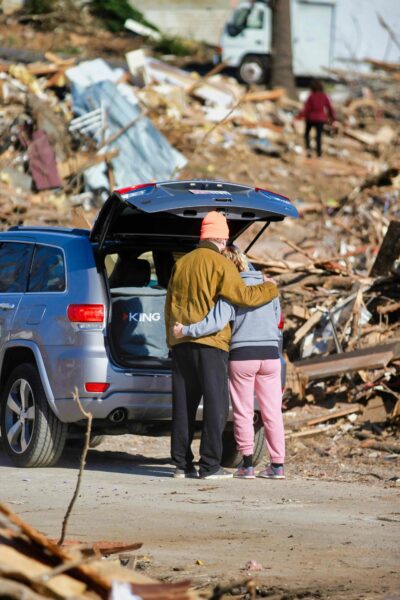
For displaced households, the emergency stay is only the beginning of a much longer recovery process; Photo by Chandler Cruttenden
That clarity has pushed Airbnb.org toward a more specific fit: localized, rapid-response short-term housing deployed at scale. One direction is focusing on smaller, localized disasters where housing needs are more likely to be temporary. Another is its Medical Stays program, which pairs families needing to travel for care with hosts offering free accommodation, facilitated through civil society partners. Launched in October 2025, the program now operates in nine countries. “With medical stays we can scale really quickly,” Gorder explains. “There’s very little physical risk. So we can just grab any organization who is ready to work with us and go.” In May 2026, Airbnb.org announced a 20 million peso — more than $1.1 million — commitment to expand the program to thousands of Mexican families traveling for specialized care.
In parallel, Airbnb.org is piloting a program designed to address a specific gap in the domestic violence response: the period between the acute crisis moment — which requires physical safety, case management, and mental health services — and access to permanent housing.
In all of these cases, success hinges on the complementarity of organizational capabilities, with trust at its center.
What makes the model work at the local level is less the technology itself than the human infrastructure around it. Kathryn is an Airbnb host and ambassador who listed her California property with Airbnb.org and housed a family displaced by the Eaton Fire. “I wrote to them: this is a place for you to find peace and comfort, to have quiet time to think of your next steps,” she says. When she and her son sat down with the family in person, she witnessed the impact firsthand. “They were effusively thanking us, over and over.”
The warm referral from a trusted source, the face-to-face conversations, the note about next steps — all point to what distinguishes this model from a hotel voucher or a shelter bed. At each node in the journey, there is a committed, vetted human being.
This is Airbnb.org’s distinctive advantage, and it is difficult to replicate. For supporters, Airbnb's emphasis on shared local experience makes its philanthropic arm feel less like a corporate initiative and more like a natural extension of what its community already values. For critics, that same connection makes it impossible to separate the nonprofit’s humanitarian promise from the housing-market effects of the platform that helped create it.
And therein lies a tension that is difficult to ignore.
Responses like the one in Los Angeles are often praised for their speed and practicality. They also trigger an understandable skepticism: is this humanitarian infrastructure, or a corporate-adjacent effort that distracts from Airbnb’s own role in housing pressures? In December 2025, the Spanish government fined Airbnb €64 million for advertising unlicensed tourist rental homes. Cities from Barcelona to New York have tightened rules on short-term rentals in response to concerns about housing supply, affordability, and neighborhood stability. Research on long-term impacts has also found that Airbnb listings can increase the supply of short-term rentals while decreasing the supply of long-term rental units.
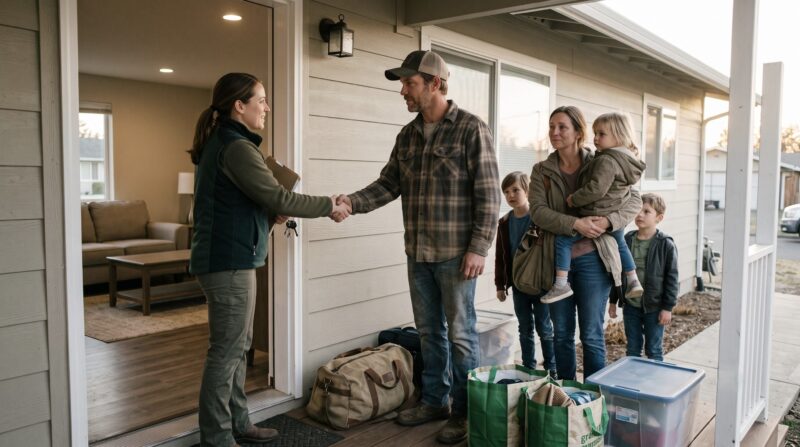
A family arrives at temporary housing after displacement — the moment where emergency response, local trust, and platform capacity either come together or fail.
The criticism has merit. It also risks obscuring larger structural issues: the commodification of housing, the high cost of borrowing, and persistent underinvestment in affordable homes. Airbnb’s success has hinged on its disruptive business model, its robust platform, and an unprepared regulatory landscape. That success, like it or not, helps fuel its philanthropy. Do we need it to? Can we accept that a single actor might both weaken and strengthen a community’s fabric? And if we can, what forms of accountability should follow?
FEMA’s Transitional Sheltering Assistance program remains the U.S. federal government’s primary emergency housing mechanism after major disasters. Even when the agency is working, survivors can experience bureaucratic burden, fragmented information, and delays; FEMA has also become an easy target for misinformation. Beyond the U.S. context, governments’ increasing reliance on regional and third-sector actors for disaster management leaves a widening gap between the resources needed and the resources that are not only available, but visible. So who is stepping up?
Crisis response works better when people and institutions build the system together before the emergency call comes in.
By 2050, an estimated 1.2 billion people could be displaced globally by ecological threats, according to the Institute for Economics and Peace. War and political unrest are permanent fixtures, and these interrelated pressures fuel a rise in gender-based violence which, in the case of domestic abuse, elevates the risk of homelessness. Short-term shelter solutions share a common ceiling: they are designed for acute crisis, not the prolonged recovery that displacement actually requires. That timeline demands a different approach — one that leverages relationships, rebalances access to resources, and includes beneficiaries in its design.
One name for this is co-production: the work of service providers and users designing and delivering public goods together. The language can sound technical, but the principle is simple. Crisis response works better when people and institutions build the system together before the emergency call comes in.
For 211 LA, the answer begins with infrastructure established before the next disaster, not after it. “When a crisis occurs, people who want to help raise their hand,” Marin says, “and so it’s incumbent on those of us who have capacity and infrastructure to reach out and say, let’s come together.” Out of the Eaton Fire response, 211 LA, the Red Cross, Airbnb.org, the Salvation Army, and other partners are now building what they call the Crisis Care Plan Alliance — a standing coalition designed to function before the emergency call comes in.
It is, in miniature, what a policy response to displacement could be: distributed, pre-coordinated, and honest about the difference between an ambulance and a healthcare system. Both matter. But while the system is redesigned, someone has to drive the ambulance. The question is whether we care who that is.


Related Content
Connecting Georgia’s social enterprises to markets and capital
102
0
Gabriel Grant on giving shareholders a way to express what matters to them
107
0
For mission-led organizations, a change of manager tests whether workplace inclusion is built to last.
84
0

Artist Rob Strati on inherited objects, the limits of market price, and the creative possibilities…
121
0
Comments
Deep Dives
RECENT
 457
0
457
0
 465
0
465
0
 425
0
425
0
Editor's Picks
 102
0
102
0
 107
0
107
0
 84
0
102
0
107
0
84
0
84
0
102
0
107
0
84
0
Webinars

Signed and personally inscribed — you'll write the inscription as you order. Limited · 50…
News & Events

The board can add 2% for each 50% rise in the company’s value

Applications close December 2, or sooner once 250 arrive

Repeat borrowers in Colombia and Indonesia took it over the line
Subscribe to our newsletter to receive updates about new Magazine content and upcoming webinars, deep dives, and events.
Become a Premium Member to access the full library of webinars and deep dives, exclusive membership portal, member directory, message board, and curated live chats.


0 Comments