What a Broken Plate Reveals About Value
Artist Rob Strati on inherited objects, the limits of market price, and the creative possibilities…



Artist Rob Strati on inherited objects, the limits of market price, and the creative possibilities…

 60
60
 0
0

Counting what we fail to prevent, sixty seconds at a time
73
0

How collateral rules and payment terms keep impact capital out of reach
 181
0
181
0

How states can crowd in local early-stage capital
356
0

Why last-mile healthcare needs an operating model, not just more mobile clinics
 332
0
332
0
How Australia’s succession wave could turn ownership into a funding model
 442
0
442
0

 748
0
748
0

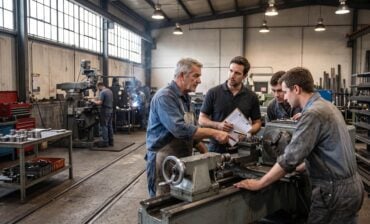
Employee ownership asks boards to rethink who has access to information, authority, and long-term enterprise responsibility; Photo by Getty Images
Employee Ownership Trusts are often discussed as succession tools, but their deeper lesson may be about governance. Through examples including Clegg Auto, Optimax, The Ready, and Text-Em-All, Douglas E. Singer and Katie Lyon show how EOTs can help private company boards think differently about transparency, trust, employee agency, and long-term enterprise value.
Imagine a multi-site retail business that implements a new profit-sharing program designed to motivate employees by sharing quarterly profits from each individual store. At the end of the first quarter, the company announces that three of its four locations are profitable, and employees at those stores will receive a profit-sharing payment. Employees at the fourth store, which broke even, will not.
Management is surprised when employees object. They argue that profits should be shared on a company-wide basis, noting that employees at the fourth store worked just as hard. Employees at the profitable stores then establish a program to generate ideas to help improve profitability at the fourth location.
It is an amazing story — and it is true.
The company, Clegg Auto Group, changed its ownership structure to an Employee Ownership Trust (EOT) through support provided by Common Trust, which included a profit-sharing arrangement designed to reinforce shared enterprise performance across locations. The deeper lesson is not simply about profit sharing. It is about how ownership structure can reshape the way employees understand the enterprise, their responsibilities to one another, and the long-term value they are helping to create.
This article explores lessons that private company boards can learn from EOT-owned companies — even when a company is not ready, or not yet ready, to adopt an EOT structure.
An Employee Ownership Trust is a trust that owns all or part of a company. Instead of a person or family serving as the sole beneficiary of the trust, the beneficiary is typically a customized purpose statement focused on the long-term perpetuation of the company and the values that shaped its growth. In practice, an EOT recognizes the contributions of the workforce by, among other things, rewarding employees with a share of profits and involving them in certain company or operational decisions.

When employees can see how the business is performing, transparency becomes a tool for shared problem-solving and long-term value creation; Photo by Getty Images
Many EOTs also provide that the company cannot be sold, or can be sold only under limited circumstances. In that sense, an EOT is not only a succession or ownership structure. It is also a governance design choice — one that can help protect a company’s mission, culture, and stakeholder commitments over time.
EOTs can offer a range of benefits, including reduced employee turnover, improved margins, stronger workforce culture, and deeper customer-employee relationships. These benefits are not automatic. They depend on how the structure is designed and, even more importantly, how the company is led. But in well-functioning EOT-owned companies, many of these benefits derive from a shift in how employees approach their work. They begin to see themselves not simply as workers, but as stewards of the enterprise.
That mindset can affect how employees relate to one another, to customers, and to the organization as a whole. Employee-owners are often more focused on long-term success at all levels, and on how the company interacts with its stakeholders — including owners, employees, customers, suppliers, communities, and the environment. In short, they feel deeply invested in the company.
Employee ownership is not only a matter of who holds shares. It is a way of asking what kind of company is being built, for whom, and over what time horizon.
Companies with EOTs also tend to be purpose-driven. Internally, they often have a clear understanding of the company’s values, purpose, and legacy. Externally, they tend to be intentional about their impacts on stakeholders. These attributes provide guideposts for management and employees in both day-to-day operations and larger strategic decisions.
Optimax
Optimax is a Rochester-based technology company that transitioned to EOT ownership in 2020. The company describes itself as embracing a team empowerment workplace environment. Optimax sets its strategic goals through input from customers, vendors, and employees. It also provides real-time reports and dashboards to all employees, creating the data and feedback loops employees need to make informed decisions and offer recommendations that create value for the company.
As one employee put it, he not only tries to support himself and his own goals, but also wants to make sure he is pulling his weight so that everyone else has the opportunity to pursue their own goals as well. That sense of shared responsibility is not incidental. It is part of the company’s operating culture. Employee engagement in problem-solving and innovation has helped Optimax sustain a strong long-term growth trajectory.
The Ready
The Ready is a purpose-driven consultancy that converted to EOT ownership as part of a broader effort to align its ownership structure with how the company already operated. The company was built on a foundation of self-management and distributed authority. That means, for example, that any member of the company has the authority to propose a new agreement or changes to an existing agreement or policy. Any member also has the authority to take action as long as that action has not been explicitly constrained.
Trust does not mean removing accountability. It means designing systems in which employees have both the authority and the context to act responsibly.
In addition, The Ready’s compensation data is transparent, which means employees have greater power to understand and shape what they make rather than relying on traditional leadership approval processes. The Ready views these management practices as central to maintaining its competitive advantage. It is highly adaptive because strategic leadership comes from across the organization, not only from the top.
The company implemented an EOT to protect and uphold its organizational values and management structure while enabling the founder to exit with minimal disruption to operations.
Text-Em-All
Text-Em-All is a SaaS company based in Texas that implemented an EOT in 2023 and became 100% employee-owned. At Text-Em-All, employees describe togetherness as “part of the magic” of the company. The company has a public-facing statement of its values and explains how those values translate into specific actions. It also has a public-facing “culture code,” which builds from the company’s stated purpose to “deliver messages that matter.”
Its cultural guiding principles were adapted from Patrick Lencioni’s The Five Dysfunctions of a Team and focus on employees trusting each other, embracing healthy conflict, committing to a plan, holding each other accountable, and focusing on results. For example, Text-Em-All holds a weekly company-wide Scoreboard meeting, using open-book management practices to foster a better understanding of what each team is doing and why, while also providing a forum to discuss important issues.
The EOT has helped reinforce that culture. Employees feel a responsibility to do right by their colleagues and co-owners. Many also express an obligation to preserve and grow the company for future employees. As a result, the EOT has helped employees at all levels adopt a long-term view rather than focusing solely on short-term initiatives and outcomes.
For companies with a well-functioning workforce, EOT-owned companies offer valuable lessons in how to deepen engagement, strengthen culture, and align daily decisions with long-term value creation.

The strongest ownership cultures are built through everyday practices of listening, accountability, and shared purpose; Photo by Dylan Gillis
For companies experiencing workforce challenges — such as significant employee turnover, lack of motivation, or quality and performance issues — the lessons may be even more important. Boards do not need to wait for an ownership conversion to ask whether the company’s governance, communication practices, and management systems are helping employees contribute at their full potential.
What can private company boards learn from EOT-owned companies and apply to their own organizations? Three lessons stand out: transparency, trust, and togetherness.
Transparency
In EOT-owned companies, there is often a high degree of transparency. Management and employees are open about successes, challenges, goals, and financial performance. Communication is two-way rather than strictly top-down. Everyone in the workforce is viewed as a responsible contributor and therefore needs the knowledge required to contribute meaningfully.
A key reason this approach works is that employees feel motivated to succeed not simply individually, but on a company-wide basis. Transparency can be empowering. By giving employees real-time information, support, and authority, companies enable them to make more effective decisions and contribute ideas that enhance the value and success of the business.
For boards, the lesson is straightforward: ask whether employees have access to the information they need to improve the company. If financial performance, customer feedback, operational bottlenecks, and strategic priorities are visible only to senior leadership, the organization may be leaving significant intelligence untapped.
Transparency also contributes to pride and satisfaction in one’s work, which can improve the quality of the company’s products or services and reduce employee turnover. In this way, transparency is not a soft cultural add-on. It is an operating discipline.
Trust
An EOT-owned company approaches its employees with a high degree of trust. Each employee is viewed as a responsible contributor who can be trusted with the latitude to address issues, solve problems, and engage the company’s stakeholders creatively and effectively.
Trust does not mean removing accountability. It means designing systems in which employees have both the authority and the context to act responsibly. Recognizing and tapping into the potential of each employee, while trusting employees to make sound decisions, can motivate people to succeed.
If financial performance, customer feedback, operational bottlenecks, and strategic priorities are visible only to senior leadership, the organization may be leaving significant intelligence untapped.
Of course, this does not happen in a vacuum. Trust works best when employees are surrounded by a supportive company culture, clear expectations, and shared information. The result is a workforce more likely to go the extra mile with customers, suppliers, colleagues, and other stakeholders — not merely for short-term performance, but for the long-term health of the enterprise.
For boards, the question is whether the company’s systems assume employee responsibility or employee limitation. Policies, approval structures, and reporting practices send strong signals about what leadership believes employees are capable of contributing. Boards that want stronger workforce performance should examine whether the company is creating the conditions for trust to become productive.
Togetherness
In an EOT-owned company, there is often a strong sense that employees at all levels are working together toward a shared goal, and that the company succeeds or fails as a result of collective effort. Individual contribution matters, but so does what the group can accomplish together and how it does so.
Building a culture of togetherness means that employees understand, feel connected to, and support the company’s values and desired stakeholder impacts. They are focused not only on their own roles, but also on the company’s legacy and the difference it seeks to make in the world.
That connection is a powerful motivator. It can influence employee behavior, company performance, customer experience, and long-term resilience. A culture of togetherness is not workplace sentimentality. It is a way of aligning enterprise performance with the people who create that performance.
For boards, the practical question is whether the company is organized around shared purpose or fragmented incentives. If teams, locations, or departments are rewarded in ways that encourage internal competition at the expense of enterprise-wide success, the company may be undermining its own long-term value. The Clegg Auto example illustrates the opposite: employees understood the business as a shared enterprise and acted accordingly.
There are many valuable lessons boards of privately owned companies can learn from EOT-owned companies. Boards can take a more active leadership role by working with senior management to apply these lessons — not as abstract values, but as governance practices that affect information flow, decision-making, employee engagement, and stakeholder relationships.
Employee ownership is not only a matter of who holds shares. It is a way of asking what kind of company is being built, for whom, and over what time horizon. For private company boards seeking long-term value creation, that may be the most important lesson of all.



Related Content
Artist Rob Strati on inherited objects, the limits of market price, and the creative possibilities…
60
0
Counting what we fail to prevent, sixty seconds at a time
73
0
How collateral rules and payment terms keep impact capital out of reach
181
0

Why free education tools need reliable access, credible evidence, and lasting support
 239
0
239
0
Comments
Deep Dives
RECENT
 356
0
356
0
 332
0
332
0
 442
0
442
0
Editor's Picks
 60
0
60
0
 73
0
73
0
 181
0
60
0
60
0
73
0
181
0
181
0
60
0
60
0
73
0
181
0
Webinars
Signed by the author. Collected at the door at Lipton Hall, NYU School of Law,…
News & Events

The September 14 program and a live IFI Tool demo are online

Pre-seed and seed startups can apply on a rolling basis

Their Built platform helps teams design, launch and run funds
Subscribe to our newsletter to receive updates about new Magazine content and upcoming webinars, deep dives, and events.
Become a Premium Member to access the full library of webinars and deep dives, exclusive membership portal, member directory, message board, and curated live chats.


0 Comments